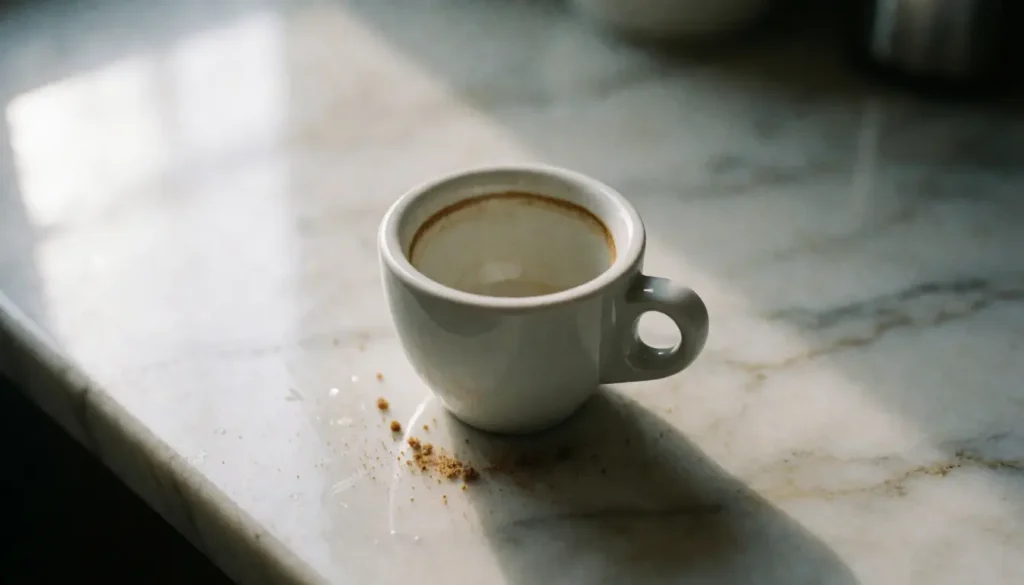
The saucepan was aluminium, dented at the rim, with a handle worn dark from use. It sat on the draining board next to a cup and a fork missing a tine.
I came to Vila Nova de Milfontes on a Tuesday bus and the guesthouse kitchen was already full. Not of people. Of evidence. A jar of instant coffee with a spoon standing in it. A bag of oats folded shut with a clothes peg. Sardine bones in the bin, still bright.
There were four of us that week. A woman from Lisbon who grilled sardines on a tabletop grill every night. The smell reached the second floor. A Dutch man who ate oats twice a day and nothing else, stirring them with a fork because the only spoon was stuck in the coffee jar. A German couple who seemed to live on bread and tinned tomatoes. And me.
The kitchen was a corridor, really. A counter along one wall, a sink at the far end, a two-ring hob on a shelf. One saucepan. One pot of any kind. There was a kettle, a cutting board, and two knives. But just the one saucepan, always back on the counter by the time the next person walked in.
On the third morning I came down for coffee and found a piece of paper taped above the stove. Blue ballpoint, neat letters. Not the owner’s handwriting. I’d seen the owner’s writing on the Wi-Fi password stuck to the fridge, all capitals, leaning hard to the right. This was different. Four names in a column, each with a time slot. Morning and noon for the oats man. Early evening for the sardines. After that for the German couple. Last slot at night for the backpack, which was me. I stood and read it twice. Someone had decided this and written it down and I had not been consulted and I did not mind.
Nobody discussed it. The Dutch man came in, boiled his oats, washed the saucepan, put it back. The woman from Lisbon took it next, filled it with water for her grill. The German couple used it together, warming their tomatoes. I took my turn and made pasta with whatever was left in the jar on the shelf. The saucepan was always clean. Always back. Always ready for the next name on the list. It worked for five days without a single conversation about it. I’d seen something like this before, in Ayvalik, where a wooden crate became a shelf and a table without anyone saying a word.
On the sixth day the Dutch man left. He packed his bag at dawn and I heard the front door close. The paper came down by lunchtime. I found it in the bin under the sink, folded in half. The new arrival was a woman from Madrid. She looked at the kitchen, looked at the saucepan, and asked me if there was a system. I said not anymore.
I keep meaning to ask someone about this. Not the saucepan itself. The way four strangers built a rota on a piece of paper and followed it for five days without speaking. The handwriting was careful. The slots were fair. Whoever wrote it had thought about the oats man needing two turns a day. I never found out who did it. I think it was the woman from Lisbon, because her grill took up the most counter space and she might have felt she owed something. Or maybe not.
If you’re thinking about it
- Guesthouses along the road inland from the river are cheaper than those near the waterfront.
- Late August gets crowded but mornings stay cool enough for a walk before the heat builds.
- Bring a universal plug adapter as shared kitchens rarely have spares.
- Skip the restaurants on the main square and walk toward the bridge instead.
- A towel is useful as the guesthouse ones are thin and changed infrequently.
I’ll be here a while longer.