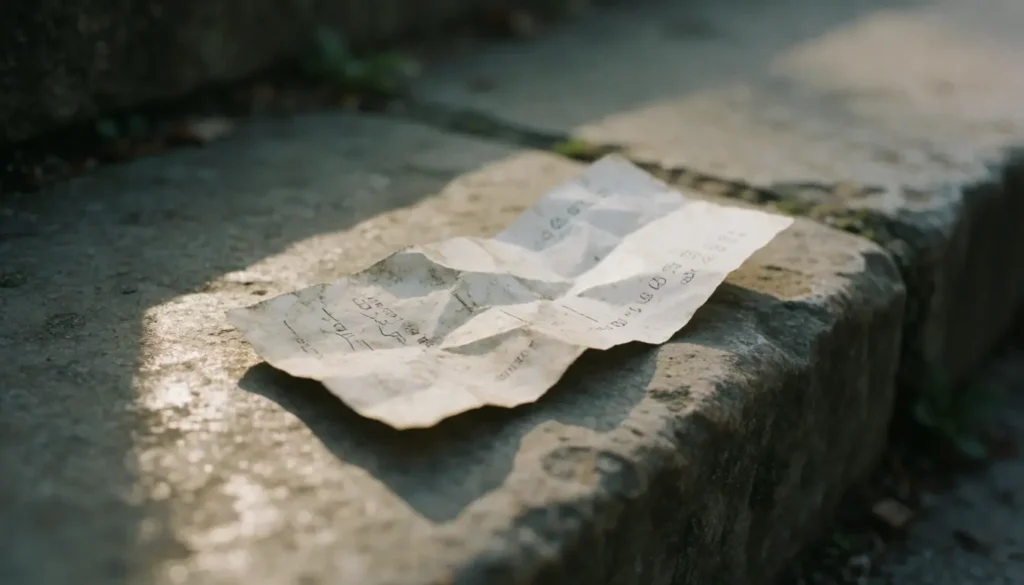
The ticket was crumpled and the ink had smudged where my thumb pressed. I turned it over. The back was blank, which was unusual for these regional bus tickets. The front said Sines, or had said Sines before the ink blurred.
I’d been in Vila Nova de Milfontes for nearly three weeks by then. Longer than I’d planned. The room had a fan that clicked every rotation, and I’d stopped hearing it during the day but never at night.
I started writing numbers on the back of the ticket because I was waiting for the bus and had nothing else to do. Room. Food. Bus fares. The market where I’d bought tomatoes and a small melon. I added them in batches, the way I used to tally drug doses at three in the morning. My handwriting was small and slanted uphill, the way it always is when I write on my knee.
The woman at the pastelaria counter had given me too much change twice this week. I hadn’t gone back either time. That isn’t what this is about.
The total came out lower than I expected. I checked it twice. Then a third time, because the first two checks felt like they’d missed something. I turned the ticket over and started again on the other side, but there wasn’t enough blank space. I wrote smaller.
The room I’d taken was above a print shop that never seemed to open. Cheap, cheaper if you paid by the week. The owner’s son, a man in his forties who smelled like engine oil, had showed me the room with hand gestures and the few Portuguese words I’d picked up. He pointed at the fan and the shower and the blue curtain. Then he left. The window looked out over a narrow street. At night I could hear someone practising guitar badly. The same four bars, over and over.
I ate at the market. Bread and olives. Sardines grilled on a brazier by a woman who only cooked fish and only late in the morning. She never smiled but she always gave me extra bread. I think she thought I was too thin. The tomatoes were split at the stem and better than any I’d had in years.
There was a cat that slept on the wall outside the print shop every afternoon. It didn’t move when I stepped over it. Once I sat on the wall next to it and it opened one eye, decided I was acceptable, and closed it again. We sat like that for a while.
The town thinned out by early afternoon. The beach crowd went home or went to lunch. I’d walk along the river and watch the water change as the tide moved. There was a bench where an old man sat every day with a newspaper he never turned the page of. I don’t know if he was reading or just sitting.
I bought a bottle of red wine once and drank it on the steps outside the room. The guitar player stopped at nine. I noticed because the silence was louder than the playing had been.
In Kampot, the power cut every evening and I’d sit in the dark counting what I’d spent that day. This felt similar. The same instinct to account for things when there’s nothing else to do.
The number on the ticket was under what I’d budgeted for the month. Not by a small amount. I folded it and put it in my pocket. Then I took it out and checked again. The bus came. I put the ticket away and got on.
I’m not sure what to do with a number that comes in low. For seven years I ran short on sleep and ran long on stress, and the budget was always tight in ways that had nothing to do with money. The flat in Hamburg sits empty most months now, tenants paying rent I barely track. I could spend more here. I don’t. Something about the low number feels like a problem I haven’t identified yet. The ticket is still in my pocket. I haven’t thrown it away.
If you’re thinking about it
- August crowds thin by mid-September and weekly room rates drop
- The market near the river bridge has the cheapest food, arrive early
- Regional buses to Sines and Odemira run infrequently, check return times
- Skip restaurants on the main street and walk two streets back
- A light jacket is enough for mornings even when afternoons are hot
I’ll be here a while longer.