The display case has several shelves and I only want one thing on them. I point. The woman behind the counter wraps it in thin paper without asking what I mean.
I have been in Vila Nova de Milfontes long enough that the bread has become a habit. I eat the same thing every morning and I still do not know its name.
The bakery sits on a corner where two narrow streets meet. The awning is faded blue and the door is propped open with a brick. Inside, the air is warm and smells of yeast and burnt sugar. I walk in, nod at the woman, and point at the tray near the glass. She nods back. This is the entire transaction, every day.
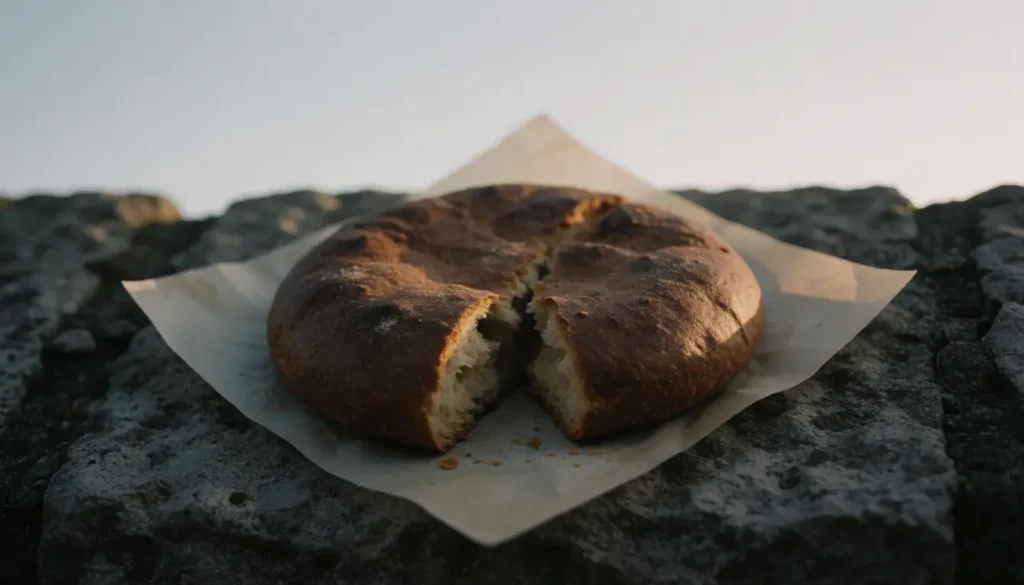
The bread is round and flat, about the size of my open hand. The crust is dark, almost black at the edges, dusted with something that might be semolina or might just be flour that caught the heat. Inside it is soft and slightly hollow. It tears instead of slices. I eat it standing by the harbour wall, pulling pieces off and watching the boats.
The first morning I came in, I tried to read the labels. They were handwritten on small cards, but the handwriting was loopy and the Portuguese was beyond me. I pointed at the round one because it was closest to the glass. She picked it up, weighed it, said a number, and I paid. It cost less than I expected. I have been pointing at the same spot on the same tray since then. I wrote about the room above this bakery before, but I did not mention the bread because I had only just arrived.
I think it might be called something like broa, but broa is cornbread and this does not taste of corn. It tastes of wheat and salt and a faint smokiness I cannot trace. There is no label on the tray now. The card might have fallen off. Or maybe it was never there and I am remembering wrong.
The woman has grey hair cut short and wears a white apron with a burn mark near the hem. She has never tried to sell me anything else. One morning a man in front of me ordered several items by name, gesturing at nothing, and she moved around the case filling boxes with a speed that made me dizzy. When it was my turn I pointed. She looked at me as if to say, same as always. I nodded.
Some mornings I eat half on the walk back and save the rest. It goes stale by afternoon but the stale version is almost better. It breaks into pieces and holds its shape. The seagulls have figured this out. They wait on the harbour wall every morning now, not aggressive, just patient. I give them the last crusts. They take them to the rocks below and hammer them apart.
I keep meaning to ask someone what the bread is called. Not the woman, because by now it would be strange. Weeks of pointing and then suddenly a question. But someone in the queue, maybe. Or the man who sells figs near the bus stop. I rehearse the sentence in my head sometimes. Como se chama este pão. I think that is right. It has the right shape, the way Portuguese sounds to me. But then I get to the counter and I point and the sentence stays in my head and the bread comes out wrapped in paper and I walk to the harbour.
If you’re thinking about it
- Bakeries in Vila Nova de Milfontes open early, before the morning heat.
- Pointing works. Most counter staff understand a gesture faster than a mispronounced word.
- The round flat bread keeps all day if you store it somewhere dry.
- Bring a small cloth bag. The paper tears against the crust.
- Avoid midday when the school across the street empties out and the queue runs to the door.
I’ll tell you the rest if I remember it.