The wind pushed hard enough that I had to plant my feet. I stood with my back to it for a while, then turned sideways to look at the stack.
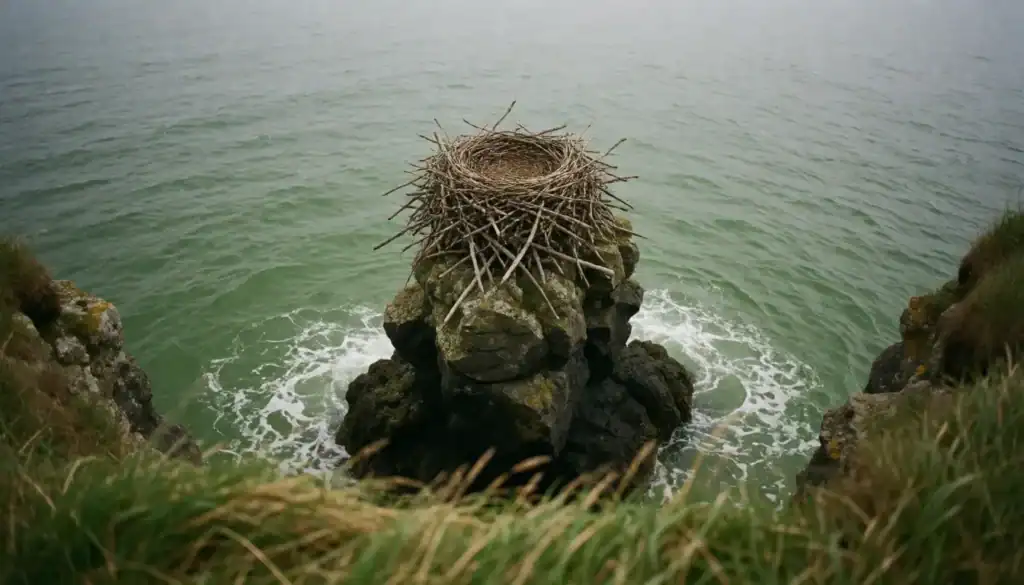
I had come to Cabo Sardao because someone told me the storks nest on the rock stacks out in the sea. This sounded wrong to me. Storks nest on rooftops and telephone poles. They belong in fields and villages. I went to see anyway.
The path from the lighthouse ran over low scrub and dry grass. The cliff edge dropped straight down into green water that turned dark further out. White froth hit the rocks below in a steady rhythm. I could feel the spray on my face from ten metres up. The wind came in flat and heavy, not gusting but pressing. I leaned into it slightly.
I had spent the morning on a river crossing that left me sandy and tired, but the walk out along the cliffs cleared that. The first stack I saw was maybe thirty metres offshore. A flat-topped pillar of dark rock with a nest on it. A big nest. Sticks piled half a metre high, wedged into a crevice near the top. A white stork stood in the middle of it, turning its head in slow movements. The bird looked completely settled, as if the rock had been built for the nest and the nest for the wind. A second stork circled once and landed on the edge. The first bird did not move. They stood apart on the same pile of sticks.
There were more stacks further south along the cliff line. I walked along the edge, keeping my weight low against the wind. Each stack had at least one nest. Some had two. The nests were massive, built from thick branches that looked too heavy for a bird to carry. On one stack a stork was rearranging a stick, pulling it up and tucking it into the base. The wind did not seem to bother it at all. The bird worked steadily, as though the Atlantic was a mild inconvenience and nothing more. I stood there for a long time watching that one bird. It kept pulling the same stick, adjusting it, stepping back, then pulling it again. I did not take a photo. I don’t know why.
The lighthouse behind me was white with a red dome. A fence ran around the base with a sign I could not read from where I stood. The paint was peeling in long strips down the south wall. Below the cliff the water churned white against the rocks and then smoothed out into a flat surface further out to sea. The contrast was sharp. I thought about how the storks had decided this was home. Not the quiet fields inland or a chimney in a village. This exposed place with wind and salt and waves hitting the rock below. They came back to it each year and rebuilt the same pile of sticks in the same spot. I suppose the nest is the point, not the location. Or maybe the location is the point and I do not understand what makes a good location for a stork.
I sat on a flat rock near the edge. The wind dropped for a few minutes and then came back harder. A man with a walking stick and a small dog passed behind me. The dog ignored me completely. The man nodded. They continued south along the cliff path and disappeared around a bend. I stayed where I was. My hair was tangled and my eyes stung from the salt. I watched the stork on the furthest stack stand up, rearrange itself, and sit back down on the same spot. It did this three times while I watched. Then it looked out at the sea and stayed completely still. I got up eventually because the wind was giving me a headache and my feet were numb from sitting on cold rock. I walked back toward the lighthouse and the wind hit my face again.
My mother kept a leather notebook in the drawer of the hallway table. I took it with me when I left Hamburg. I do not write in it every day. Today I wrote one line and then sat looking at the page. The storks build on rock in the wind. That was all I wrote. I am not sure what I meant by it. I am not sure I meant anything.
Getting there
I left the town early and walked south along the coast road until the path turned to dirt and climbed toward the headland. The walk took over an hour and the last stretch was open ground with no shade. I could see the lighthouse from far off, white against the brown scrub. There was a small parking area near the base but I did not see any cars when I arrived.
When to go
Late July on this coast means hot afternoons and mornings that still feel cool. The town has been getting more crowded each week but the cliff path was almost empty. I passed two people in two hours. The heat builds by midday and the wind near the cliffs is strong enough that you forget how warm it is until you walk back inland. I was sweating by the time I reached the road again.
If you’re thinking about it
- Bring water for the walk in. There is nothing along the cliff path and the sun is direct.
- Wear shoes with grip. The rock near the edge is smooth in places and the wind makes balance harder than you expect.
- The wind is constant at the cliff edge. A hat will not stay on.
- Stay back from the edge. The wind is strong enough to push you off balance and the rock is exposed.
- If you want to see the nests, walk south past the lighthouse along the cliff. The first stack is visible from the lighthouse but the better nests are further along.
I’ll tell you the rest if I remember it.